UPI Guard – AI-Powered UPI Fraud Detection System
Detect suspicious payment patterns using machine learning, graph analytics, and explainable fraud alerts.
Project overview
What this project is about.
UPI Guard is an AI-powered fraud detection and analysis system designed to help identify suspicious patterns in digital payment transactions. It demonstrates how machine learning and graph-based analysis can work together to investigate potentially fraudulent financial activity. The project is designed for students who want to understand how artificial intelligence can be applied to cybersecurity, financial technology, and fraud analytics.
Traditional rule-based fraud detection systems rely on predefined conditions, such as unusual transaction amounts or specific transaction patterns. However, suspicious activity can sometimes be difficult to identify by examining individual payments alone. For example, several accounts might send money to a common account, which then transfers the funds to another account within a short period. Although individual transactions may appear ordinary, the relationships between accounts can reveal a potentially suspicious pattern.
UPI Guard addresses this challenge by analyzing transaction information and incorporating graph-based features that describe relationships between accounts. It compares three approaches: traditional rule-based detection, machine learning using LightGBM with transaction-level features, and LightGBM enhanced with graph-based features. This comparison helps students understand how different fraud detection approaches can be evaluated using the same experimental dataset.
The system uses LightGBM, a machine learning algorithm based on gradient-boosted decision trees, to estimate the fraud risk associated with transactions. Graph-based features provide additional information about account relationships and money-flow patterns. The system can present suspicious activity through an alert queue and provide explanations to help users understand why a transaction or account was flagged for investigation.
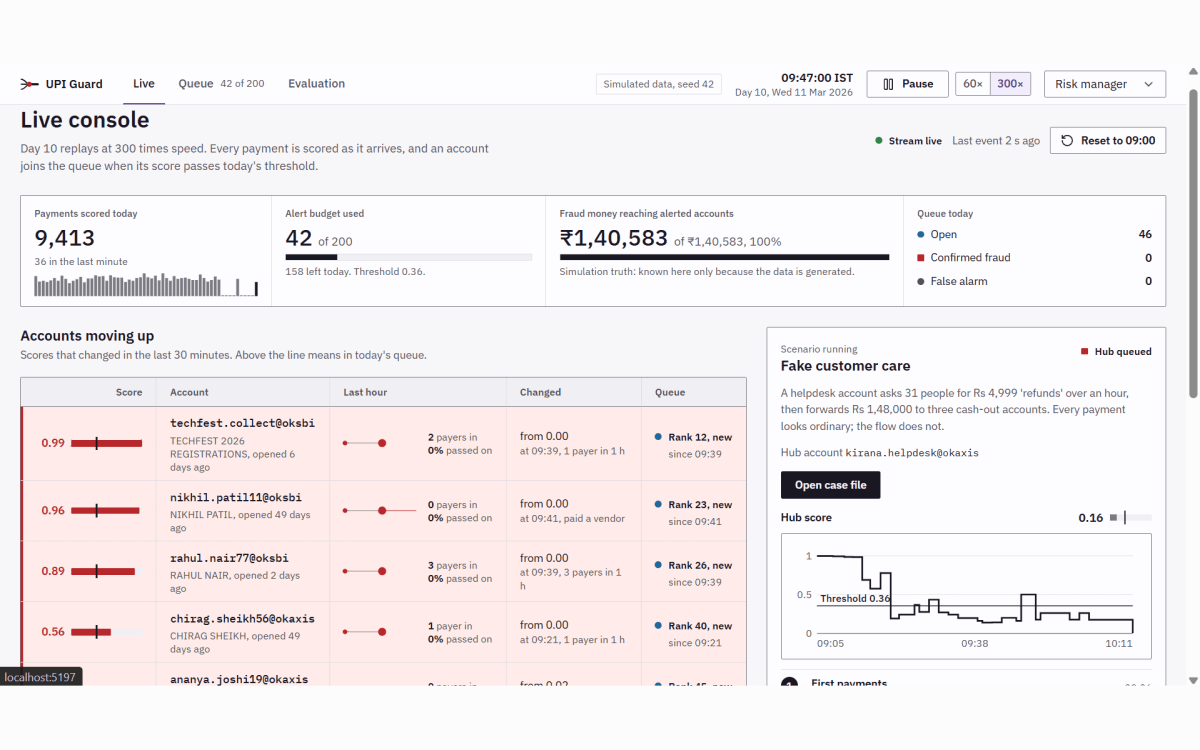
UPI Guard also includes an interactive fraud simulation and investigation workflow. Students can explore simulated transaction activity, examine connected accounts, review alerts, and understand how different detection approaches behave. These features make the project suitable for learning about machine learning, graph analytics, fraud detection, model evaluation, and explainable artificial intelligence.
The application uses a Python-based backend, a React frontend, FastAPI for API services, LightGBM for machine learning, and SQLite for data storage. It is designed to run locally on a computer using simulated transaction data, making it suitable for demonstrations, experimentation, and academic project presentations without requiring a connection to live UPI infrastructure.
UPI Guard is an educational and research-oriented project for final-year students interested in AI, machine learning, cybersecurity, and financial technology. It provides a practical opportunity to explore how transaction analysis, account relationships, and machine learning can be combined to investigate suspicious payment activity.
Who it is for
Usage and use case
- Explore simulated digital payment transactions and investigate potentially suspicious activity.
- Compare traditional rule-based fraud detection with machine learning approaches.
- Analyze transaction-level information and graph-based account relationship features.
- Run fraud simulation scenarios and observe the resulting alerts.
- Investigate suspicious accounts, review their transaction relationships, and understand why activity was flagged.
- Study model evaluation results and compare the performance of different detection approaches.
- Use the project for academic demonstrations, machine learning experiments, and final-year project presentations.
Built with
Technology stack
- Python
- React.js
- FastAPI
- LightGBM
- SQLite
- Graph-based feature engineering
- Machine Learning
- REST APIs
What you get
Key features
- Rule-based transaction fraud detection
- LightGBM machine learning model
- Graph-enhanced fraud detection
- Transaction pattern analysis
- Account relationship and money-flow analysis
- Fraud risk scoring
- Suspicious transaction alerts
- Explainable fraud detection results
- Interactive fraud simulation
- Transaction replay and analysis
- Account investigation workflow
- Fraud alert queue
- Comparison of three detection approaches
- Model evaluation and performance metrics
- Interactive React dashboard
- Python and FastAPI backend
- SQLite database integration
- Local execution using simulated data
Before you start
Requirements
Python 3.10 or a compatible version specified by the repository
Node.js and npm
A modern web browser
Git
Required Python dependencies
Required frontend dependencies
Sufficient local storage for the application, dependencies, and datasets
A Windows, Linux, or macOS computer
Project media
A closer look.
Optional extras
Boost your project
Optional extras to help you document, present and understand your work. Mention the ones you like when you enquire.
-
Popular Documentation support Submission-ready project report. - Full project report (PDF and Word)
- Setup guide and README
- Diagrams and screenshots
-
Presentation support Slides ready for your review. - Slide deck of 12 to 15 slides
- Speaker notes
- Demo walkthrough script
-
Publication support Guidance to turn it into a paper. - Paper structure and abstract
- Journal and format guidance
- Reference and plagiarism-check help
-
1:1 mentorship Live help from a mentor. - 45-minute video call
- Code walkthrough
- Viva question practice
How do I get a project?
Open the project you like and use the button on its page. If online payment is available you can pay and choose how you want to receive it. Otherwise send us a short enquiry and we will reply on WhatsApp or email.
Can a project be changed to fit my requirements?
Yes. Describe the changes you need when you enquire, and we confirm the scope and the price before any work starts.
Are add-ons available?
Many projects have optional add-ons such as documentation or presentation support. They are listed on the project page with their prices, and you can pick them when you buy or enquire.
How will I receive my order?
You choose email, WhatsApp or a Google Drive link. The delivery time is shown on the project page and in your confirmation email.
Is there a demo?
Projects with a demo video have a play button on their page. If you want to see something specific, ask us and we will tell you what we can show.
Can I get a refund?
Projects are digital, so payments are generally not refundable. If something went wrong, send a refund request with your order reference and we review it fairly. The Refund Policy explains the details.