StudyMind AI — An intelligent platform for personalized exam preparation.
AI-powered exam preparation platform that organizes notes, analyzes PYQs, and generates personalized practice papers intelligently.
Project overview
What this project is about.
StudyMind AI is an intelligent academic exam-preparation platform designed to help college students study more effectively.
Users can create subjects and upload their study materials as PDF files. The application processes these documents, extracts their text, and converts the content into searchable knowledge using artificial intelligence.
Students can ask questions through the AI Study Assistant. The system searches the uploaded notes and provides answers based on the relevant study material. Answers include document and page-level citations so students can verify the information easily.
StudyMind AI also allows users to upload Previous Year Question Papers, commonly called PYQs. The system extracts questions from these papers, identifies repeated topics, analyzes question frequency, studies marks distribution, and displays historical examination patterns.
Using the analyzed PYQ data, students can generate AI-powered model question papers. They can select the number of 2-mark, 5-mark, and 10-mark questions and create a structured practice paper.
The platform can also generate marks-aware answers for model-paper questions. Short questions receive concise answers, while higher-mark questions receive detailed explanations with important points, examples, and conclusions.
Generated model papers can be viewed online and downloaded as professional PDF documents.
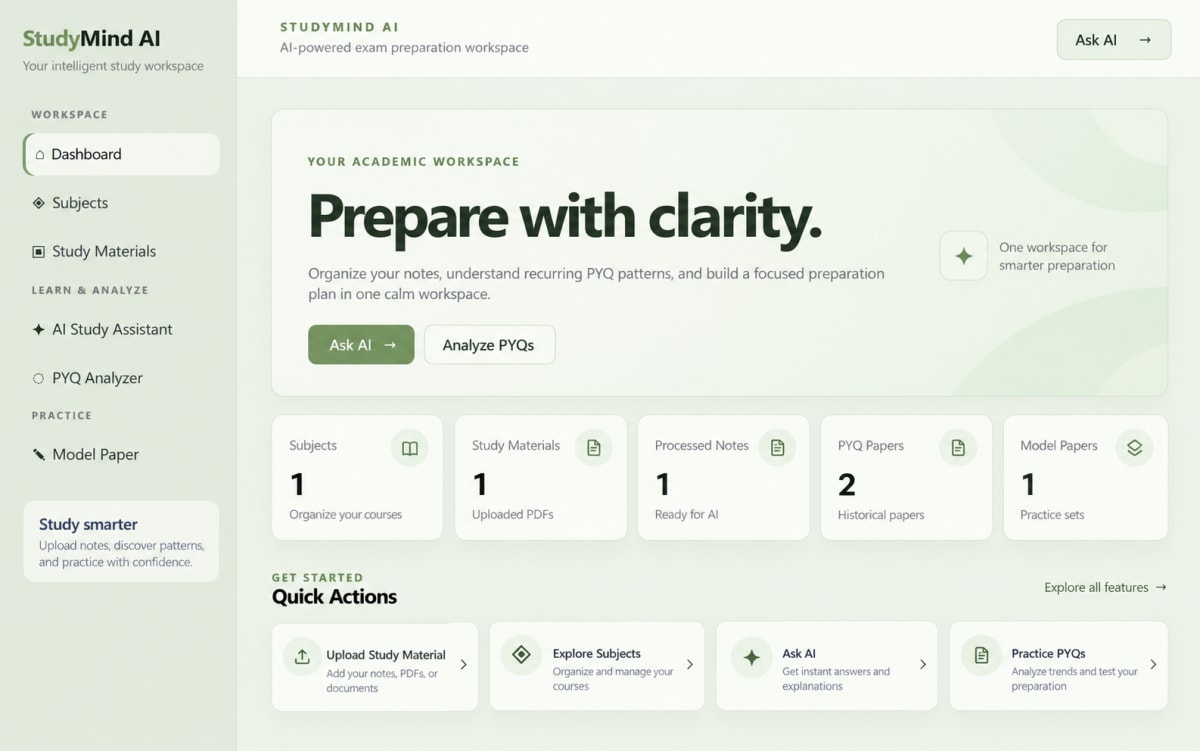
The application is designed with a clean, responsive, and professional academic interface. It includes a fixed navigation sidebar, dashboard statistics, subject management, study-material management, PYQ analysis, AI chat, model-paper generation, and PDF export.
StudyMind AI helps students organize their preparation, understand important historical question patterns, revise from their own notes, and practice with automatically generated examination material.
Key features
- Subject management
- Study-material PDF upload
- PDF text extraction
- AI question answering from uploaded notes
- Page-level source citations
- PYQ upload and processing
- Repeated-topic and question-pattern analysis
- AI model-paper generation
- Marks-aware answer generation
- Model-paper PDF export
- Dashboard statistics
- Responsive academic user interface
Technology stack
PythonDjangoDjango REST FrameworkHTML5CSS3JavaScriptDjango TemplatesSQLitepython-dotenvPyMuPDFSentence Transformersall-MiniLM-L6-v2ChromaDBGroq APIscikit-learnAgglomerative ClusteringReportLabChart.jsPowerShellGit
Usage and use case
1. Create a subject such as Operating Systems, Computer Networks, or Database Management Systems.
2. Upload study-material PDFs for the selected subject.
3. Process the uploaded study materials so the system can extract text and create searchable embeddings.
4. Open the AI Study Assistant and select a subject.
5. Ask questions about the uploaded notes. The AI provides answers with document and page citations.
6. Ask general academic questions. If the answer is not available in the uploaded notes, Groq generates a general academic response.
7. Upload Previous Year Question Papers from the PYQ Analyzer section.
8. Process the uploaded PYQ papers to extract questions and analyze their patterns.
9. Select a subject and load the PYQ analysis.
10. Review frequently repeated topics, question frequency, years, units, marks, and importance scores.
11. Open the Model Paper section and configure the required number of 2-mark, 5-mark, and 10-mark questions.
12. Generate a model question paper using historical PYQ patterns.
13. Generate marks-aware answers for individual model-paper questions.
14. Download the completed model paper as a PDF.
15. Use the dashboard to monitor subjects, study materials, processed notes, PYQ papers, and generated model papers.
Requirements
Windows 10 or Windows 11
Python 3.10 or newer
Internet connection
Groq API key
At least 4 GB RAM
At least 2 GB free storage
Modern web browser
Python virtual environment
PDF study materials
Previous Year Question Paper PDFs
Project add-ons
Additional add-ons for this project.
Ask about project-specific add-ons through the ProjectVybe enquiry channel.
Documentation support
Create clear, well-structured project documentation covering implementation, technologies, features, methodology, and project outcomes.
Presentation support
Prepare professional project presentations that clearly explain your project idea, workflow, technologies, implementation, results, and key highlights.
Publication support
Get guidance in preparing and structuring project work for technical papers, research publications, and academic submission requirements.
1:1 mentorship
Get personalized guidance from project planning and technology selection to implementation, debugging, documentation, and final presentation.
Frequently asked questions
Questions about this project.
How can I ask about this project?
Use the enquiry button to share the project context and the kind of support you are looking for. ProjectVybe will review the enquiry and respond directly.
Is a demo available?
A YouTube demo has not been added for this project yet.
Can I request changes or additional support?
Yes. Describe your requested changes or learning goals in an enquiry so the ProjectVybe team can review them.
Are project add-ons available?
The available project add-ons are listed above and can be selected when you send an enquiry. Add-ons are enquiry-based; no online checkout or public pricing is provided.
How do I get started?
Review the project information, then use the enquiry button to send the details you would like to discuss.
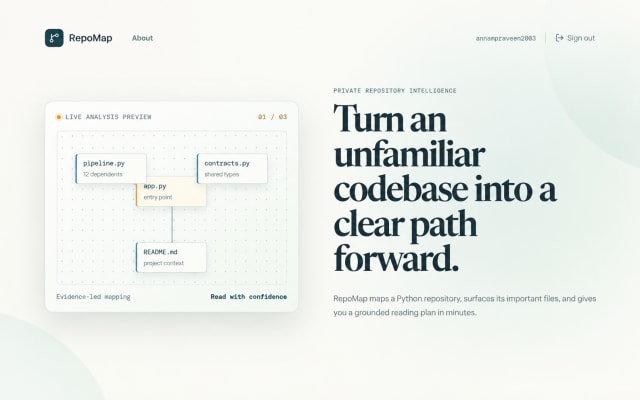
RepoMap - Python Repository Intelligence & Codebase Analysis Platform
Map Python repositories into evidence-based onboarding guides, dependency graphs, histories, and PDF reports.
View project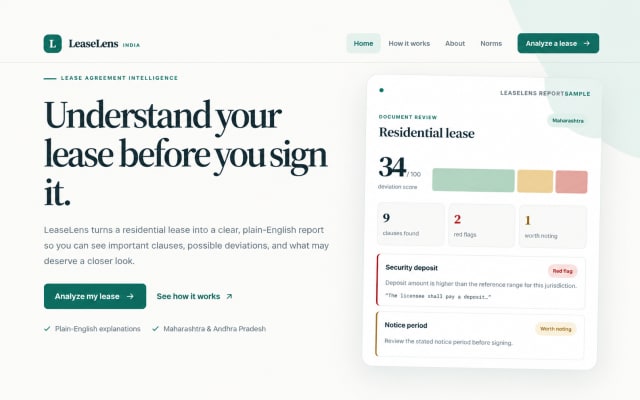
LeaseLens – AI-Powered Lease Agreement Analyzer
AI-powered LeaseLens analyzes residential leases, extracts clauses, compares norms, and explains risks through clear reports.
View project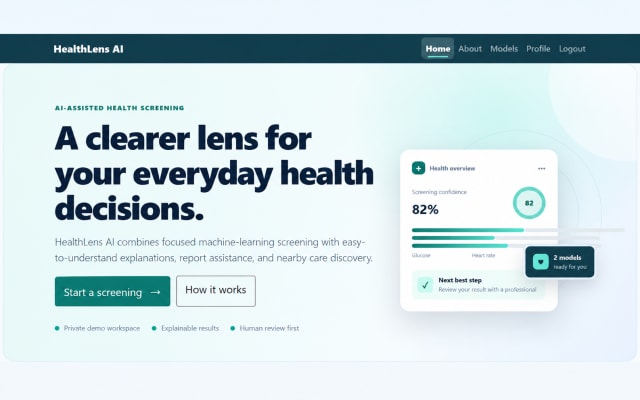
HealthLens AI | AI-Powered Health Risk Screening
Explore HealthLens AI, an educational AI and machine-learning application for diabetes and heart disease risk screening, AI-assisted report analysis, and healthcare discovery.
View projectBuild. Learn. Grow.
Ready to discuss this project?
Send ProjectVybe the project context you are exploring, or continue browsing the published catalogue.